Some acquisitions are about prestige. Others are about continuity. When François-Paul Journe quietly secured a historic pocket watch by Abraham-Louis Breguet at auction in Geneva in November 2025, the moment felt less like a headline and more like a full circle.
“Forty-three years ago, I completed my first tourbillon,” Journe said after the sale. “I am proud to have won at auction the most beautiful tourbillon by Abraham-Louis Breguet.” It is a statement that reveals more than admiration. It reads as a dialogue across centuries, between a modern independent watchmaker and the inventor who laid the foundations of his life’s work.
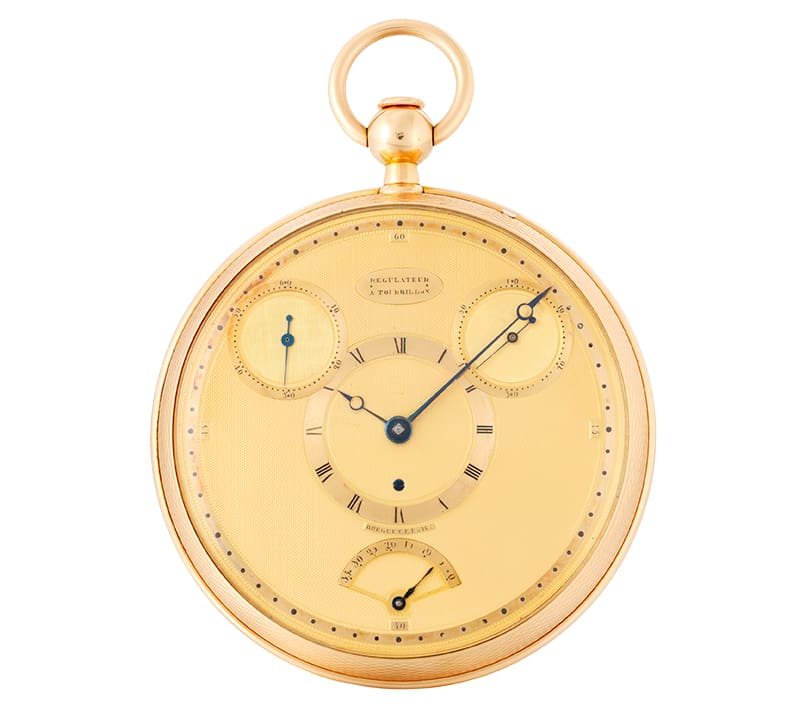
The watch in question—Breguet No. 1890—dates back to 1809 and was originally sold to Count Alexis de Razoumoffsky, a minister to Tsar Alexander I. What elevates it beyond rarity into near-mythical status is its technical composition. It unites two of Breguet’s most consequential inventions: the tourbillon and the natural escapement. Only eight known Breguet watches are believed to combine these two complications, making No. 1890 not just scarce, but structurally significant in the history of horology.
This is not a trophy acquisition. Journe did not acquire the watch to seal it away in a private vault, nor to inflate the market value of an archive. Instead, No. 1890 will become a cornerstone of the forthcoming F.P.Journe Le Patrimoine museum, a space conceived to preserve both Journe’s own creations and the historical timepieces that shaped his philosophy. The museum’s ambition is intellectual rather than commercial: to place modern independent watchmaking in direct conversation with its origins.
The symbolism is layered. Breguet’s tourbillon was designed to correct positional errors in pocket watches—an engineering solution rooted in observation and restraint. Journe’s own work has long echoed those same principles: precision without excess, complexity justified only by purpose. That No. 1890 also features the natural escapement—a mechanism Breguet himself believed held the future of chronometry—adds another layer of meaning. It is innovation frozen at the moment of its birth.
The watch has been extensively documented, including its inclusion in The Art of Breguet by George Daniels, further cementing its status as a scholarly reference point. In that sense, its placement within Le Patrimoine feels inevitable. The museum is not being positioned as a shrine to Journe alone, but as a map—tracing where contemporary independent watchmaking comes from, and why it still matters.
In an industry increasingly driven by hype cycles and aesthetic novelty, this acquisition feels deliberately out of step. It is slow, considered, and deeply personal. By bringing Breguet No. 1890 into public view through Le Patrimoine, François-Paul Journe is making a quiet but powerful statement: that the future of haute horlogerie is inseparable from its past, and that true innovation is rarely loud when it is authentic.