Signé Magazine
  • Cars
  • Watches
  • Style
    • Fashion
    • Accessories
    • Grooming
  • Signé Woman
    • Fashion
    • Jewellery
    • Beauty
  • Lifestyle
    • Gear
    • Travel
    • Hotels
    • Fine Dining
    • Real Estate
  • Art & Design
  • Festive Picks!New
Browse
  • Cars
  • Watches
  • Style
    • Fashion
    • Accessories
    • Grooming
  • Signé Woman
    • Fashion
    • Jewellery
    • Beauty
  • Lifestyle
    • Gear
    • Travel
    • Hotels
    • Fine Dining
    • Real Estate
  • Art & Design
  • Festive Picks!New
Search
Signé Magazine
Signé Magazine
  • Cars
  • Watches
  • Style
    • Fashion
    • Accessories
    • Grooming
  • Signé Woman
    • Fashion
    • Jewellery
    • Beauty
  • Lifestyle
    • Gear
    • Travel
    • Hotels
    • Fine Dining
    • Real Estate
  • Art & Design
  • Festive Picks!New
  • Art & Design

Indar Pasricha to showcase a “Golden Moment” of European textiles

  • August 16, 2018
  • 3 minute read
Total
0
Shares
0
0
0
0

“There is a wonder that is captured in the textiles of Europe from the 16th to the 19th centuries“, says Indar Pasricha, Gallery Curator of Indar Pasricha Fine Arts which will be hosting an exhibition titled ‘Apparell’d in Celestial Light’ between September 26 and November 3, 2018.

It is an “Exhibition of Masterpieces of 16th – 19th Century European Textiles, including Christian Vestments.”  The selling exhibition provides a rare opportunity to view or purchase breath-taking textiles that were gathered over the past 20 years from collections in France, Spain, Italy, Austria, Germany, the United States and Great Britain.

The exhibition has two distinct components. The first one highlights a “golden moment” in European textile production from 1690 to 1720. In this period, “textile design had brought together, in earlier manifestations, the influence of China, India and later those of Islamic Spain on the indigenous European aspects of pattern and colour. There were no barriers to borrowing from the various cultures which were thrown together by the trade carried out between disparate traditions,” says Indar Pasricha.

This “golden moment” began at the end of the 17th century, seemingly out of nowhere, and held sway in most of the important centres of weaving in Europe. It was a new and extraordinary design idea, which because of its asymmetrical and odd aspect was known as ‘Bizarre’. It was short-lived though, lasting but a few years, and had petered out by the 1720’s. Some experts had thought that these fabrics, which were predominately woven in silk, came from India because of the exotic nature of their design. This was disproved when the pattern books of these Bizarre silks were found in France, Italy and Britain. The complexity of design and weave were never to be seen again. It was indeed a “golden moment”.

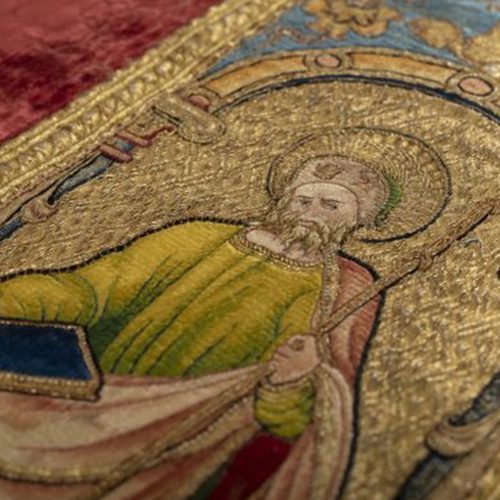
The second component of the exhibition is the collection of Church Vestments. “Many of these beautiful vestments started life as clothes worn by aristocratic women and the peacock-like clothes of their men who then donated them to the church. The costly fabrics which were used were then redesigned to make spectacular vestments for the priests,” says Indar Pasricha. At a time when most of the population wore very basic, dull clothes, these vestments would have had the effect of causing wonder and amazement among the congregation at the church.

Detail from El Greco’s The Burial of the Count of Orgaz (1586-88) in San Tomé, Toledo
An embroidered detail of a church vestment
An embroidered church cope
Embroidery on a chasuble made in Lyon or Italy about 1740
Chasuble
Vestment made for palace Chapel of Philip II of Spain, heavy with gold
Back of a Chasuble,Lyon.Bizarre silk weave,circa 1720
Vestment made for palace Chapel of Philip II of Spain, heavy with gold
A pair of Orphreys, Spanish, 17th Century

The role of these priestly vestments was to contribute to the dignity of the rites being celebrated. The names of the generations of designers, master craftsmen and artisans who produced these works of the weaver’s art remain largely nameless. Many of these textiles were cared for and loved as heirlooms in churches and monastic orders for centuries. Their equivalents are found in the world’s leading museums.

These woven and embroidered vestments constitute an alternate ‘textile’ narrative for the Christian Church in Europe, South America, China and India. The materials used in these vestments were produced in the countries into which Christianity had been taken. Christianity thus took on the aspects of the indigenous cultures of these countries.

One example is a crimson velvet chasuble that was part of the vestments used in a funeral mass. It features silk taffeta cartouches of six skulls and crossbones and bordered by silk and gold polychrome embroidery. It appeared in the 16th century and commemorates ‘The Day of the Dead’, a pre-Christian ritual celebrated in Mexico. The design is a chilling reminder of the cost of Spanish colonisation in South America as well as an example of the infusion of indigenous Mexican culture into the Christian church. The skull and crossbones were a favourite design on these objects. The church of the Escorial possesses four paraments so decorated, which were shown, in 1878, at the Paris Exhibition of Retrospective Art.

Another chasuble made around 1840 for the Bishop of Macau features Lotus flower motifs. The exhibition also has two vestments that are thought to have been made of Indian fabric, one woven, the other painted, both dated to the 18th century and made for the priests in Goa. Both territories were then Portuguese enclaves.

These historical fabrics display not just extraordinary designs and virtuoso weaving, but to those with educated fingers, these vestments tell a story of their own; they are in effect messages from the past.

It has been said by a textile restorer: “Our fingers can ‘read’ the weave of these fabrics, and you can tell as you work across a piece if the weaver was having a good or a bad day at the loom hundreds of years ago. It’s almost a sort of time Braille. The cloth channels human emotion locked into the silk and wool.”

Indar Pasricha Fine Arts is located at 44 Moreton Street, London, SW1V 2PN. Prices range upwards from £5,000 to £1 million.

Total
0
Shares
Share 0
Tweet 0
Pin it 0
Share 0
You May Also Like
View Post
  • Art & Design

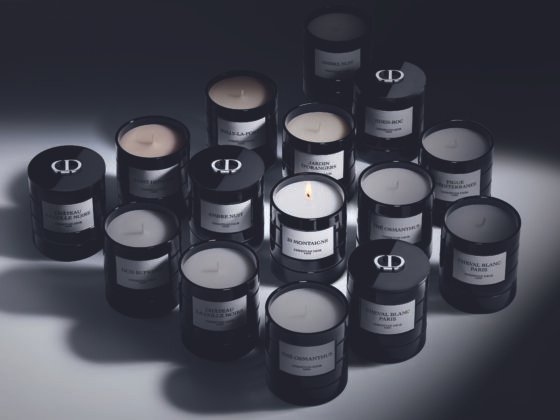
Dior Reimagines the Art of Scented Living with La Collection Privée Candle Collection

  • January 12, 2026
View Post
  • Art & Design

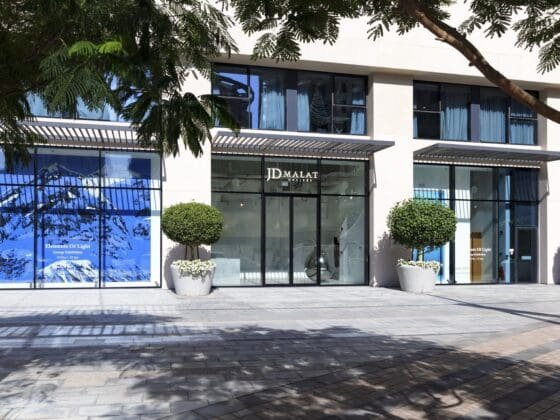
Elements of Light Illuminates Contemporary Expression at JD Malat Gallery Dubai

  • January 6, 2026
View Post
  • Art & Design

Van Cleef & Arpels Unveils Brassée de Lavande: A Mechanical Poem in Bloom

  • December 3, 2025
View Post
  • Art & Design

Poetry of Birds — L’ÉCOLE, School of Jewelry Arts, Dubai

  • November 11, 2025
View Post
  • Art & Design

Minotti’s 2025 Outdoor Collection Redefines Open-Air Living with Sculptural Design and Seamless Elegance

  • November 6, 2025
View Post
  • Art & Design

L’ÉCOLE Middle East Unveils Poetry of Birds Exhibition at Dubai Design Week 2025

  • October 28, 2025
View Post
  • Art & Design

Autumn in Bloom: The Flower Society’s Fall/Winter 2025-2026 Collection Brings Seasonal Splendour Indoors

  • October 23, 2025
View Post
  • Art & Design

Zara Home Welcomes Autumn/Winter 2025 with a Warm Embrace of Seasonal Charm

  • October 11, 2025
Signé Sanctuaries
  • A Return to Radiance: The Maybourne Riviera Welcomes the 2025 Season With New Culinary Stars and a Groundbreaking Wellness Destination
  • AVANTCHA Unveils Black Oud & Mastic: A Luxurious Fusion of Wellness and Tradition
  • Renew and Rejuvenate: Rosewood Abu Dhabi’s Longevity & Renewal Retreat
  • Clinique La Prairie Elevates Skin Rejuvenation in Revitalisation Programs Through Collaboration with La Prairie
  • One&Only Le Saint Géran Unveils Mauritius First Guerlain Spa: A Fusion of Elegance and Wellness
LATEST STORIES
  • Four Extraordinary Saudi Escapes to Experience This Winter Season
  • Beit El Sabban Brings Soulful Egyptian Home Cooking to AlUla Oasis
  • Nissan Celebrates the NISMO Legacy as Performance Moves from Track to Road
  • Time Well Spent: Ed Ruscha and the Art of Noticing the Everyday
  • Brunello Cucinelli Unveils a Refined Abaya Capsule for Fall Winter 2025
  • Dior Reimagines the Art of Scented Living with La Collection Privée Candle Collection
  • The Ferrari That Defined an Era: Alfonso de Portago’s 250 GT Tour de France Heads to Paris
  • Jaquet Droz Revives Botanical Poetry with the Petite Heure Minute Red Gold – Hummingbird
  • Banyan Group Celebrates a Global Milestone with the Opening of Mandai Rainforest Resort by Banyan Tree in Singapore
  • Dior Introduces Haute Motherhood, A Refined Wellbeing Journey Dedicated to the Postpartum Experience

Make your Inbox more interesting.

Every alternate week get a packaged update from the world of luxury. A newsletter tastefully curated by the 'Keepers of Craft', Signé Magazine.

Latest Print Editions
    • Print Edition

    Signé Magazine – Edition 55

    • 15.11.24
      • Print Edition
    View Post
    • Print Edition

    Signé Magazine – Edition 54

    • 24.09.24
      • Print Edition
    View Post
    • Print Edition

    Signe Magazine – Edition 52

    • 15.12.23
      • Print Edition
    View Post
    • Print Edition

    Signé Magazine – Edition 51

    • 15.11.23
      • Print Edition
    View Post
    • Print Edition

    Signé Magazine – Edition 50

    • 15.09.23
      • Print Edition
    View Post
Latest Online Features
  • Four Extraordinary Saudi Escapes to Experience This Winter Season January 13, 2026
  • Beit El Sabban Brings Soulful Egyptian Home Cooking to AlUla Oasis January 13, 2026
  • Nissan Celebrates the NISMO Legacy as Performance Moves from Track to Road January 13, 2026
  • Time Well Spent: Ed Ruscha and the Art of Noticing the Everyday January 13, 2026
  • Brunello Cucinelli Unveils a Refined Abaya Capsule for Fall Winter 2025 January 12, 2026
  • Dior Reimagines the Art of Scented Living with La Collection Privée Candle Collection January 12, 2026
EDITORIAL CALENDAR
January 2026
S M T W T F S
 123
45678910
11121314151617
18192021222324
25262728293031
« Dec    
Signé Magazine
  • Signé Magazine – All Stories
  • Contact Us
Keepers of Craft

Input your search keywords and press Enter.